Octopus

Octopus
The Ominous Octopus
Showing posts with label Paul Terry. Show all posts

Sunday, February 8, 2015

Paul Terry Ad

An old ad for Paul Terry cartoons mentions "Aesop's Fables", which was the name of the cartoon series he was working on at the time. The character of Farmer Alfalfa, shown here, would continue to appear in Terrytoons for years.


A

Mighty Mouse Ad


Mighty Mouse is shown here with a blue costume. In later cartoons he was given a yellow costume.


A

Sunday, January 12, 2014

Terrytoons


Paul Terry produced a series of cartoons which were very successful in theatrical release, later moving into television.


Terrytoons

From Wikipedia, the free encyclopedia
        
   
Terrytoons
IndustryAnimation
Founded1929
Defunct1968
HeadquartersK Building, New Rochelle, New York, United States
Key peoplePaul Terry
Terrytoons was an animation studio founded by Paul Terry. The studio, located in suburban New Rochelle, New York, operated from 1929 to 1968. The studio created many popular cartoon characters including Heckle and Jeckle, Mighty Mouse, Gandy Goose, Sourpuss, Dinky Duck and Luno. The "New Terrytoons" period of the late 1950s and 60s brought us Sidney, Hector Heathcote, Hashimoto and Deputy Dawg as well as The Mighty Heroes. Famed animator Ralph Bakshi got his start at Terrytoons. Terrytoons were originally released to theaters by 20th Century Fox. Today they are owned by CBS Corporation.

History

Before Terrytoons
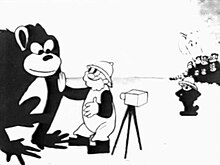

Farmer Al Falfa in "River of Doubt" (1927)
Terry first worked for Bray Studios in 1916, where he created the Farmer Al Falfa series. He would then make a Farmer Al Falfa short for Edison Pictures, called "Farmer Al Falfa's Wayward Pup" (1917), and some later cartoons were made for Paramount Pictures.
Around 1921, Terry founded the Fables animation studio, named for its Aesop's Film Fables series, in conjunction with Amadee J. Van Beuren. Fables churned out a Fable cartoon every week for eight years in the 1920s. In 1928, Van Beuren, anxious to compete with the new phenomenon of talking pictures, released Terry's Dinner Time (released October 1928). Van Beuren then urged Terry to start producing actual sound films, instead of post-synchronizing the cartoons. Terry refused, and Van Beuren fired him in 1929. Almost immediately, Terry and much of his staff started up the Terrytoons studio.

Heyday

Through much of its history, the studio was considered one of the lowest-quality houses in the field, to the point where Paul Terry noted, "Disney is the Tiffany's in this business, and I am the Woolworth's." Terry's studio had the lowest budgets and was among the slowest to adapt to new technologies such as sound (in about 1930) and Technicolor (in 1938), while its graphic style remained remarkably static for decades. Background music was entrusted to one man, Philip Scheib, and Terry's refusal to pay royalties for popular songs forced Scheib to compose his own scores. Paul Terry took pride in producing a new cartoon every other week, regardless of the quality of the films. Following the success of Disney's Snow White and the Seven Dwarfs Paul Terry considered doing an animated feature film adaptation of King Lear starring Farmer Al Falfa. However, after seeing the failure of Max Fleischer's Mr. Bug Goes to Town, and the additional failures of Disney's Pinocchio and Fantasia he decided to abandon the project. Until 1957, screen credits were very sparse, listing only the writer (until 1950, solely John Foster, then Tom Morrison thereafter), director (Terry's three main directors were Connie Rasinski, Eddie Donnelly and Mannie Davis), and musician.
Terrytoons' first distributor was Educational Pictures, specialists in short-subject comedies and novelties. The Fox Film company (later known as 20th Century-Fox) released Educational shorts to theaters in the 1930s, giving the Terry cartoons wide exposure. Farmer Al Falfa was Terry's most familiar character in the 1930s; Kiko the Kangaroo was spun off the Farmer Al Falfa series. Most of the other cartoons featured generic animal characters. One of the stock designs was a scruffy dog with a black patch around one eye; Terry ultimately built a series around this character, now known as Puddy the Pup.
Paul Terry may have realized that Educational was in financial trouble, because he found another lucrative outlet for his product. In 1938 he arranged to release his older cartoons through home-movie distributor Castle Films. Educational went out of business within the year, but 20th Century-Fox continued to release Terrytoons to theaters for the next two decades. With a new emphasis on "star" characters, Terrytoons featured the adventures of Super Mouse (later renamed Mighty Mouse), the talking magpies Heckle and Jeckle, silly Gandy Goose, Dinky Duck, mischievous mouse Little Roquefort, and The Terry Bears.
Despite the artistic drawbacks imposed by Terry's inflexible business policies, Terrytoons was nominated four times for the Academy Award for Animated Short Film: All Out for V in 1942, My Boy, Johnny in 1944, Mighty Mouse in Gypsy Life in 1945, and Sidney's Family Tree in 1958.

Changing hands

The studio was sold outright by the retiring Paul Terry to CBS in 1955, but 20th Century Fox (TCF) continued to distribute the studio's releases. The following year, CBS put it under the management of UPA alumnus Gene Deitch, who had to work with even lower budgets.
Deitch's most notable works at the studio were the Tom Terrific cartoon segments for the Captain Kangaroo television show. He also introduced a number of new characters, such as Sick Sick Sidney, Gaston Le Crayon, John Doormat, and Clint Clobber. Deitch brought much creativity and life to the Terrytoons cartoons, but because he was only 31 years old when he came to the studio, he wasn't entirely welcome. An internal battle was fought by studio stalwarts and Deitch was forced out. Soon after Deitch moved to Prague where as of March 2011 he continues to live and work.
After Deitch was fired in 1958, Bill Weiss took control of the studio. Under his supervision, Heckle and Jeckle and Mighty Mouse went back into production. Besides the three core directors of the Terry era who were still involved as animators and directors, two Famous Studios stalwarts joined the crew, Dave Tendlar and Martin Taras. Other new theatrical cartoon series included Hector Heathcote, Luno and Hashimoto San. In addition, the studio began producing the Deputy Dawg series for television in 1960. Another television production for the Captain Kangaroo show was The Adventures of Lariat Sam, which was written in part by Gene Wood, who would later become the announcer for several TV game shows, most notably, "Family Feud".
Phil Scheib continued as the studio's musical director through the mid-1960s when he was replaced by Jim Timmens and Elliott Lawrence.
The most notable talent at Terrytoons in the 1960s was animator/director/producer Ralph Bakshi, who got his start with Terrytoons in the 1950s and later helmed the Mighty Heroes series. Bakshi left Terrytoons in 1967 for Paramount, which closed its cartoon unit later that year. He would later go on to produce Mighty Mouse: The New Adventures for television in 1987.

Post-history

After the departure of Bakshi after 1966, the studio petered out and finally closed in 1968. However, the film library was still regularly rereleased to theatres by Fox, thus ensuring its existing cartoon library a long life in TV reruns. Its last short was an unsold TV pilot called Sally Sargent, about a 16-year old girl who is a secret agent.
The Terrytoons cartoons (especially Mighty Mouse and Deputy Dawg) were syndicated to many local TV markets, and they were a staple of after-school and Saturday morning cartoon shows for over three decades, from the 1950s through the 1980s, until the television rights to the library were acquired by USA Network in 1989. They have seen relatively little air time since then.
In the 1970s, the CBS Films properties were spun off to create Viacom, which itself re-merged with CBS in 1999.
In the late '70s, Filmation Studios licensed the rights in order to make a new Mighty Mouse series. Later in 1987, Ralph Bakshi produced Mighty Mouse: The New Adventures which lasted for two seasons. Bakshi and John Kricfalusi inspired the staff to try to get as much Jim Tyer-style drawing in the show as possible. Tyer, a stand-out Terry animator of the original cartoons with a unique style, became a strong influence on the artists of the Bakshi series.
In 2002, the Terrytoons characters returned to television in original commercials for Brazilian blue cheese (for what is now America's Dairy Farmers) and a fine wine.
Through the years that have followed since the last Terrytoons TV series material in 1988, the rights have been scattered as result of prior rights issues and corporate changes involving Viacom (the ownership and distribution history is noted below). However, some Terrytoons shorts are believed to be in the public domain, and have been issued on low-budget VHS tapes and DVDs. The first official release of any Terrytoons material by CBS DVD has been announced (Mighty Mouse: The New Adventures was issued January 5, 2010).

Licensing and merchandising
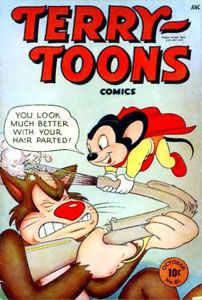

Terry-Toons Comics #61 (Oct. 1947). Cover artist unknown.
Among the many licensed Terrytoons products are comic books, with the company's characters initially licensed to Timely Comics, a predecessor of Marvel Comics, in the early 1940s. Later, St. John Publications took over the licensing, publishing comics featuring such characters as Mighty Mouse, the magpies Heckle and Jeckle, Gandy Goose, and Little Roquefort. The first such St. John comic was Mighty Mouse #5 (Aug. 1947), its numbering taken over from the Timely run. St. John's Terrytoons comics include the field's first 3-D comic book, Three Dimension Comics #1 (Sept. 1953 oversize format, Oct. 1953 standard-size reprint), featuring Mighty Mouse.[1] According to Joe Kubert, co-creator with the brothers Norman Maurer and Leonard Maurer, it sold an exceptional 1.2 million copies at 25 cents apiece[2] at a time when comics cost a dime.

Ownership

Distribution

Productions

Cartoon series

TV series

Other cartoons

References

  1. ^ Zone, Ray. 1950s 3-D Comic Book Checklist, Tay3DZone.com, n.d. WebCitation archive.
  2. ^ Joe Kubert interview, "A Myth in the World of Comics", UniversoHQ.com, n.d. WebCitation archive.

External links


                                                              *                     *                     *


Although it has been said that Terrytoons were considered to be of low quality, these cartoons still have a following today.


Reblogged from http://tralfaz.blogspot.com/

Terry’s works remain in tune
By JACQUELINE PERELSON

Mighty Mouse was born in New Rochelle. So were Heckle and Jeckle, Tom Terrific, Deputy Dawg, Dinky Duck and Hector Heathcote. They were born on the drawing boards of Paul Terry's Terrytoons animation studio located in this Westchester city for more than 40 years. This fact will be proclaimed for all to examine when the New Rochelle Council on the Arts holds a Terrytoons retrospective with an exhibition, reunion dinner, animated film showings, and other events, from Wednesday, Feb. 10 to Sunday, Feb. 28.
Whether seen in a “trailer” after a movie or as the main attraction on early morning television, these cartoon stars and others, including Billy Bear, Farmer Al Falfa, Little Roquefort and Sidney the Elephant, remain nostalgic memories for children of all ages.
Dwarfed by the impact of Disney, the work of Terry and his studios has not been given its due, said Eli Bauer, a former Terrytoons employee, and others who are planning this event. Which is the reason behind the celebration.
Doug Crane of New Rochelle, a former Terrytoons animator, agreed. “If we don’t do it now, the history of Terrytoons will be lost and people will forget it was ever in New Rochelle,” he said, just as they have forgotten that the West Side of New Rochelle was a movie production area in the ‘20s.
Descriptions of the days at Terrytoons are a series of name-dropping sessions. Comedian Dayton Allen was the voice of Heckle and Jeckle, as well as Deputy Dawg, and Dick Van Dyke did Barker Bill. There are remembrances by Bauer of visits to the studio by Jonathan Winters and Carl Reiner , who brainstormed gag ideas and also did voice-overs.
Bauer and Jules Feiffer worked desk to desk. Feiffer “knew that he would go on,” said Bauer. His time at Terrytoons “was part of his growth period” during which he was doing “Sick, Sick. Sick” for the Village Voice and working on a book of the same title.
Bill Tytla, who animated a “Night on Bald Mountain” for Disney’s “Fantasia,” started at Terry. As did Ralph Bakshi (creator of “Fritz the Cat,” “Heavy Traffic” and “Lord of the Rings) when he was just a “young kid.”
Bauer’s wife, Dianne, remembered studio employees working closely together. “This one would say ‘How about a wartime character?’ and somebody else would say ‘Right, he could be a Minute Man,’ with a third saying ‘How about a Minute-and-a-half Man because he’s always late.’ And as they pitched the story they would use different voices. The head of the story department was Tommy Morrison, now deceased, who was the voice of Mighty Mouse,” she said.
Everyone connected with Terrytoons depicted it as a spawning ground for talent throughout the animation industry with alumni going off to Disney, Hanna-Barbera, Filmation and other studios.
Crane, an animator, recalled Terry as “a tough old codger. A businessman, not an artist, who was smart enough to hire the right guys. The right guys, according to Crane, were Connie Rasinski and Artie Bartsch, both deceased, plus Johnny “Gent” Gentilella and Larry Silverman. “When I walked in there I was fascinated by the smell of the paint... I could see Connie from my desk and I thought he was cracking up. He would do a little action, look in the mirror and sit down and animate,” said Crane.
On Thursday nights Rasinski would teach animation to fledgling artists at Terrytoons and that was how a whole generation of animators learned its craft. “It’s a tough business trying to make these things move right,” Crane said. “Disney wasn't the only one who did animation,” he emphasized.
“I think that Terry gave to the world a lot of smiles in bad times and he was there for a long time. If a man does nothing but lift your spirits when you're down he’s done a great thing.”
For while Terry was the first to acknowledge that Disney was the “Tiffany's in this business” and he “the Woolworth’s,” Terrytoons was a pioneer in the field of animation and created characters that are still popular today.
With a background in newspaper art, the California-native came East in 1911, worked for the New York Press and also drew a comic strip called Alonzo. On the side, using a secondhand camera, Terry began developing techniques for animation.
“At one time he devised an early matte system in which the background would be photographed separately and then the characters and action sandwiched together to make a print. His first film was animated on paper with the background overlaid on a cel (clear acetate sheet),” said Leonard Maltin in his book “Of Mice and Magic.”
Terry sold his first animated film “Little Herman” to Thanhouser, a New Rochelle-based film company, but not before screening it for some neighbourhood youngsters in the company’s projection room. There he learned a valuable lesson.
He learned that cartoons were for “kids.”
According to Maltin, Terry said, “When they ran the picture, these kids began to squeal. And that tipped me off to the idea to draw things that would appeal to kids; because if they laughed at it, the adults wouldn’t have to know if it was funny, or whether it wasn’t, because kids’ laughter is so infectious. I decided right then and there, you make pictures for kids.”
Which he did. First as the creator of Farmer Al Falfa as a staff animator for John R. Bray and then as initiator of a series of animated cartoons based on Aesop’s Fables for Howard Estabrook. After an interruption for Army service in 1917, Terry was associated with Fables Studio, Van Beuren Productions and in various partnerships.
Terry and the late Frank H. Moser formed a partnership in 1929 with $500 in capital. They worked together until 1935, when following the studio’s move from New York City to 271 North Ave., New Rochelle, Terry bought out Moser for $24,200. A year later Moser initiated a lawsuit against Terry claiming “fraud,” but lost. The remaining firm, known as Terrytoons, moved to 38 Centre Ave. in 1949.
Terry, who lived in Larchmont until his death in 1971, headed the firm until 1956 when the studio was sold to CBS. Terrytoons closed its doors for good in the early ‘70s and its film library remains in the hands of Viacom.
“We knew we were part of a mass market,” said Bauer, who was with the studio from 1957-62 during its CBS era. In those days the studio produced 12 new cartoons a year and re-released 12 from their film library, generating a considerable output annually.
“We considered ourselves visual writers,” said Bauer, who worked as a story layout and design staffer. “We started a cartoon with a series of gags and then added the dialogue, unless the gag itself had to do with the dialogue. There’d generally be a conflict (between the characters) and that would involve a series of gags.”
The early days attracted many young and eager artists, writers and aspiring animators to the studio’s doorstep. They included the late Tommy Morrison, whose mother worked at the studio and is now celebrating her 102nd birthday in New Rochelle, and the late Philip A. Scheib; as well as Jack Zander and Joe Barbera. William Weiss was in charge of the business end as executive producer and was assisted for many years by Nicholas Alberti.
When CBS took over, Gene Deitch brought in a new crew of young talent which featured Bauer, Doug Crane, Al Kouzel, Ernest Pintoff, Howard Beckerman, Paul Terry still at work years later and Tod Dockstader. The outfit also included future super-stars Feiffer and Bakshi. Looking back, Crane recently asked, “Wasn’t it a thrill when you watched those films when Mighty Mouse came to the rescue? We thrilled and cheered. We knew he’d come through.”
And now this retrospective is coming through to ensure Terrytoons’ place in history.
JACQUELINE PERELSON is Lifestyles Editor of The Standard-Star, New Rochelle.


                                                *                   *                   *


I thought it was strange how Leonard Maltin trashed Terrytoons in his book OF MICE AND MAGIC. I have frequently run across references to the Fleischer studio being poorly thought of by the rest of the animation business, so Terrytoons and Fleischer would have been alike in that regard. It just isn't being fair to act like only Terrytoons was regarded in that way.

I also thought it was odd what this author said about Paul Terry being a success while other ( he says ) more talented people didn't make it. We who watch these cartoons need not concern ourselves with such things today. The whole point of watching cartoons is ordinarily entertainment, rather than an endless denunciation of whoever made them for purposes that are never made clear to us.


Terrytoons were at one time released by Educational pictures, whose symbol was Aladdin's lamp.


Educational released through 20th Century Fox. With the demise of Educational, 20th Century Fox took over distribution..


Mighty Mouse model sheet


Heckle and Jeckle


Oil Can Harry and Pearl Pureheart


Who are like different versions of the "Oilcan Harry" and "Fanny Zilch" of the older Terrytoons.


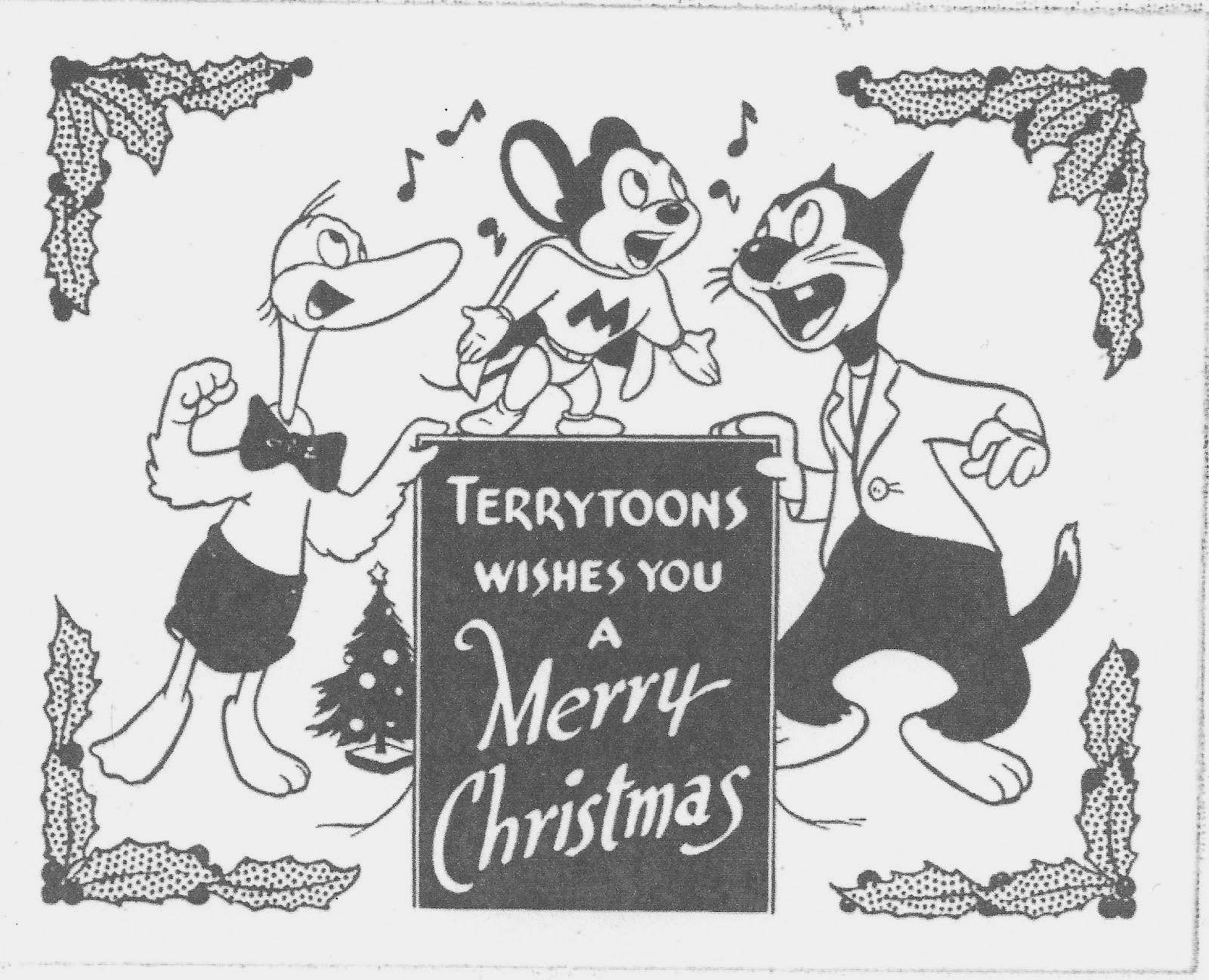
Xmas Cards reblogged from http://tommandjerrie.blogspot.com/2012/12/a-terrytoon-xmas.html


Connie and Marie Rasinski


Phis Sheib


Terrytoons studio card


Paul Terry


And here are some of the Terrytoons.


OF MICE AND MAGIC By Leonard Maltin:
http://www.cartoonbrew.com/books/of-mice-and-magic-30th-anniversary-24953.html

Terrytoons:

http://www.imdb.com/company/co0028853/

http://tralfaz.blogspot.com/

http://www.awn.com/animationworld/folks-terrytoons


A

Wednesday, June 27, 2012

The Sons Of Felix The Cat


Walt Disney's Alice comedies featured a cat that looked very much like Felix. So did many other cartoons made in that period.

Alice Comedies

From Wikipedia, the free encyclopedia
    
The "Alice Comedies" are a series of animated cartoons created by Walt Disney in the 1920s, in which a live action little girl named Alice (originally played by Virginia Davis) and an animated cat named Julius have adventures in an animated landscape.

Contents


 Alice's Wonderland

Disney, Ub Iwerks, and their staff made the first Alice Comedy, a one-reel (ten-minute) short subject titled Alice's Wonderland, while still heading the failing Laugh-O-Gram Studio in Kansas City, Missouri.
Alice's Wonderland begins with Alice entering a cartoon studio to witness cartoons being created. Alice is amazed by what she sees: The cartoon characters come to life and play around. After heading to bed that night, she dreams of being in the cartoon world, welcomed by all of the characters. Alice plays with them until a group of lions break free from a cage and chase her.
This short helped set the stage for what was to come in the later Alice Comedies, as it established the world as a playful dream and also introduced the elements which would soon define the series.

 The Alice Comedies series begins

After completing the film, the studio went bankrupt and was forced to shut down. After raising money by working as a freelance photographer, Disney bought a one-way train ticket to Los Angeles, California to live with his uncle Robert and his brother Roy. In California, Disney continued to send out proposals for the Alice series, in hopes of obtaining a distribution deal, which was finally arranged through Winkler Pictures, run by Margaret Winkler and her fianceé, Charles Mintz, on the basis of Alice's Wonderland. Disney convinced Davis' family to bring her from Missouri to Los Angeles to star in the series.[1]

 Content

Although seen as cute and funny in their time, the Alice Comedies contain content which might be considered surprising and somewhat harsh today by sensitive viewers. Alice is a little girl, yet she spends much of her time avoiding danger, and even getting kidnapped by the cartoon villains, threatened with such perils as being tied to a log in a sawmill. These scenes are parodies of similar scenes in movie serials such as The Perils of Pauline (1914), starring actress Pearl White. One such Alice cartoon, Alice's Mysterious Mystery (1926) features two cartoon characters who allegedly resemble members of the Ku Klux Klan. One of the villains drags a dog character into a room marked "Death Chamber", and pulls out a long strand of sausage. In "Alice and the Dog Catcher" she is leader of a club called the Klix Klax Klub. Where all the kids wear paper bags over their heads with their faces painted on them.

 Shorts and subsequent releases

The shorts are now in the public domain.[citation needed] In 2000, Inkwell Images released a DVD titled Alice in Cartoonland - The Original Alice Comedies by Walt Disney in the series Golden Classics with ten short films from the series as well as some documentaries and a poster gallery. In 2007, Kit Parker Films released another DVD called Alice in Cartoonland by Walt Disney: 35 mm Collector's Set with ten films from the series and a selection of bonus features. There are 14 films from the series on these two DVDs.
In 2005 and again in 2007, ten shorts in the series were released as part of the Walt Disney Treasures series. Seven were part of the Disney Rarities that was released in 2005, while three more were released as part of The Adventures of Oswald the Lucky Rabbit, released in 2007.
Walt Disney both directed and produced every film this series. All animation was done by Walt Disney himself in the period of time before he was financially stable enough to employ a team of animators for successive films. Four actresses have played Alice: Virginia Davis (15), Margie Gay (31), Dawn O'Day (1) and Lois Hardwick (10). The film Alice in the Jungle contains only archival footage of Virginia Davis.
#Short filmDateActressDVD release
1Alice's Wonderland1923Virginia DavisWalt Disney Treasures: Disney Rarities: Celebrated Shorts, 1920s–1960s
2Alice's Day at SeaMarch 1, 1924Virginia Davis
3Alice's Spooky AdventureApril 1, 1924Virginia Davis
4Alice's Wild West ShowMay 1, 1924Virginia DavisWalt Disney Treasures: Disney Rarities: Celebrated Shorts, 1920s–1960s
5Alice's Fishy StoryJune 1, 1924Virginia Davis
6Alice and the Dog CatcherJuly 1, 1924Virginia Davis
7Alice the PeacemakerAugust 1, 1924Virginia Davis
8Alice Gets in DutchNovember 1, 1924Virginia DavisWalt Disney Treasures: Disney Rarities: Celebrated Shorts, 1920s–1960s
9Alice Hunting in AfricaNovember 15, 1924Virginia Davis
10Alice and the Three BearsDecember 1, 1924Virginia Davis
11Alice the PiperDecember 15, 1924Virginia Davis
12Alice Cans the CannibalsJanuary 1, 1925Virginia Davis
13Alice the ToreadorJanuary 15, 1925Virginia DavisAlice in Cartoonland - The Original Alice Comedies by Walt Disney
14Alice Gets StungFebruary 1, 1925Virginia DavisWalt Disney Treasures: The Adventures of Oswald the Lucky Rabbit
15Alice Solves the PuzzleFebruary 15, 1925Margie GayAlice in Cartoonland - The Original Alice Comedies by Walt Disney
16Alice's Egg PlantMay 30, 1925Dawn O'DayWalt Disney Treasures: Disney Rarities: Celebrated Shorts, 1920s–1960s
17Alice Loses OutJune 15, 1925Margie Gay
18Alice Gets Stage StruckJune 30, 1925Margie GayAlice in Cartoonland - The Original Alice Comedies by Walt Disney
19Alice Wins the DerbyJuly 15, 1925Margie GayAlice in Cartoonland - The Original Alice Comedies by Walt Disney
20Alice Picks the ChampJuly 30, 1925Margie Gay(Only a fragment of this cartoon is known to exist)
21Alice's Tin PonyAugust 15, 1925Margie GayAlice in Cartoonland - 35 mm Collector's Set
22Alice Chops the SueyAugust 30, 1925Margie GayAlice in Cartoonland - 35 mm Collector's Set
23Alice the Jail BirdSeptember 15, 1925Margie GayAlice in Cartoonland - 35 mm Collector's Set
24Alice Plays CupidOctober 15, 1925Margie Gay
25Alice Rattled by RatsNovember 15, 1925Margie GayAlice in Cartoonland - The Original Alice Comedies by Walt Disney
26Alice in the JungleDecember 15, 1925Virginia DavisWalt Disney Treasures: Disney Rarities: Celebrated Shorts, 1920s–1960s
27Alice on the FarmJanuary 1, 1926Margie GayAlice in Cartoonland - The Original Alice Comedies by Walt Disney
28Alice's Balloon RaceJanuary 15, 1926Margie GayWalt Disney Treasures: The Adventures of Oswald the Lucky Rabbit
29Alice's OrphanJanuary 15, 1926Margie GayAlice in Cartoonland - 35 mm Collector's Set
30Alice's Little ParadeFebruary 1, 1926Margie Gay
31Alice's Mysterious MysteryFebruary 15, 1926Margie GayWalt Disney Treasures: Disney Rarities: Celebrated Shorts, 1920s–1960s
32Alice Charms the FishSeptember 6, 1926Margie Gay(Lost cartoon)
33Alice's Monkey BusinessSeptember 20, 1926Margie Gay(Lost cartoon)
34Alice in the Wooly WestOctober 4, 1926Margie GayWalt Disney Treasures: The Adventures of Oswald the Lucky Rabbit
35Alice the Fire FighterOctober 18, 1926Margie Gay
36Alice Cuts the IceNovember 1, 1926Margie Gay(Lost cartoon)
37Alice Helps the RomanceNovember 15, 1926Margie Gay
38Alice's Spanish GuitarNovember 29, 1926Margie Gay
39Alice's Brown DerbyDecember 13, 1926Margie Gay
40Alice the LumberJackDecember 27, 1926Margie Gay(Lost cartoon)
41Alice the Golf BugJanuary 10, 1927Margie Gay(Lost cartoon)
42Alice Foils the PiratesJanuary 24, 1927Margie Gay(Lost cartoon)
43Alice at the CarnivalFebruary 10, 1927Margie Gay(Lost cartoon)
44Alice at the RodeoFebruary 21, 1927Margie Gay
45Alice the CollegiateMarch 7, 1927Margie Gay(Lost cartoon)
46Alice in the AlpsMarch 21, 1927Margie Gay(Lost cartoon)
47Alice's Auto RaceApril 4, 1927Margie Gay(Lost cartoon)
48Alice's Circus DazeApril 18, 1927Lois Hardwick
49Alice's Knaughty KnightMay 2, 1927Lois Hardwick(Lost cartoon)
50Alice's Three Bad EggsMay 16, 1927Lois Hardwick(Lost cartoon)
51Alice's PicnicMay 30, 1927Lois Hardwick
52Alice's Channel SwimJune 13, 1927Lois Hardwick(Lost cartoon)
53Alice in the KlondikeJune 27, 1927Lois Hardwick(Lost cartoon)
54Alice's Medicine ShowJuly 11, 1927Lois Hardwick(Lost cartoon)
55Alice the WhalerJuly 25, 1927Lois HardwickWalt Disney Treasures: Disney Rarities: Celebrated Shorts, 1920s–1960s
56Alice the Beach NutAugust 8, 1927Lois Hardwick(Lost cartoon)
57Alice in the Big LeagueAugust 22, 1927Lois Hardwick

 See also

 References

  1. ^ The Hand Behind the Mouse: The Ub Iwerks Story, Leslie Iwerks, Walt Disney Pictures, 1999

 External links


One of the old Disney silents resissued with sound.


Some pretty good Felix the Cat cartoons were made by the Van Beuren studio, even when they didn't have the rights to the name "Felix the Cat". Later on they made some genuine Felix the Cat cartoons, but the series ended after only three films were made.

Van Beuren Studios

From Wikipedia, the free encyclopedia
Jump to: navigation, search
Van Beuren Studios was an American animation studio that produced theatrical cartoons from 1928 to 1936.

Amedee J. Van Beuren, 1933
Producer Amedee J. van Beuren first became involved in the animation industry in 1920, when he formed a partnership with Paul Terry and formed the "Aesop's Fables Studio" for the production of the Aesop's Film Fables cartoon series. Van Beuren released Terry's first sound cartoon Dinner Time (1928) through Pathé Exchange which later became part of RKO. Terry ran the animation studio while Van Beuren focused on other parts of the business. In 1929, Terry quit to start his own Terrytoons studio and John Foster took over the animation department. It was at this time that the Fables Studio became the Van Beuren Studio.
Van Beuren released its films through RKO Radio Pictures. The early sound Van Beuren cartoons are almost identical to the late silent cartoons: highly visual, with little dialogue and occasional sound effects. Bandleaders Gene Rodemich and Winston Sharples supervised the music. The company's main cartoon characters were "Tom and Jerry", a tall-and-short pair, usually vagrants who attempted various occupations (no relation to MGM's later Tom and Jerry, a cat and mouse). They were renamed "Dick and Larry". Van Beuren was keenly aware that successful cartoons often featured animated "stars," and urged his staff to come up with new ideas for characters. Cubby, a mischievous little bear, resulted.
Van Beuren remained unsatisfied, and agreed to license the popular comic-strip character The Little King and radio's hottest comedy act, Amos 'n' Andy to adapt into animated form. Strangely, neither series was successful. Van Beuren then hired Walt Disney staffer Tom Palmer to create a new series of color cartoons. These handsome "Rainbow Parade" cartoons featured established characters: Felix the Cat and the Toonerville Trolley gang.
These Van Beuren efforts were well received, and Van Beuren had finally succeeded in sponsoring a popular cartoon series. However, RKO ended its distribution of Van Beuren theatrical shorts in 1937 when it began distributing industry-leader Walt Disney's cartoons.
The Van Beuren Corporation also acquired and produced live-action features and shorts (including Frank Buck's monster hit Bring 'Em Back Alive). In 1932, Van Beuren purchased 12 Charlie Chaplin silent films (his 1916-'18 "Lone Star" comedies for Mutual Film Corporation) for $10,000 apiece, added music (by Rodemich or Sharples) and sound effects, and reissued them through RKO.
The Van Beuren library was sold to various television, reissue, and home-movie distributors in the 1940s and 1950s, including Commonwealth Pictures and Official Films.

 Productions

Animation:
Live-action:

 External links


Farmer Alfalfa was a Paul Terry character, but there was some overlap as he was associated with Van Beuren. Here we see the farmer with a Felix-type cat, who was a recurring character in those films.


CANDY TOWN was practically a Felix the Cat cartoon, even though they didn't call the cat that. Some of the creatures they encountered on the moon looked a great deal like some of the things they'd had in outer space in some of the old Felix the Cat cartoons.


"Waffles" was teamed with a little dog in a series of cartoons that led to the later "Tom and Jerry" series at Van Beuren.


Some people thought the Van Beuren Felix wasn't quite the same as the original, but this is a pretty good poster, and I thought the cartoons were OK.


Warner Brothers


Beans the Cat
A black cat in white overalls
Beans as seen in Hollywood Capers
Beans the Cat was the third Looney Tunes cartoon character star after Bosko and Buddy. Created by Leon Schlesinger, Beans is most likely modelled after Waffles, a feline from the Van Beuren Studio, as both characters are black-furred cats in overalls.
He made his first appearance in the Merrie Melodies cartoon I Haven't Got a Hat (1935), along with Porky Pig who would have a much longer run in the series. He then made a cameo in The Country Mouse, another Merrie Melodies short release that same year.
Before having a role in another cartoon, Beans was already seen in the "That's all folks!" closings in the last three Buddy shorts. Finally, six months following his debut film, Beans starred in A Cartoonist's Nightmare which would be his first solo cartoon, followed by Hollywood Capers. Beans then began appearing with characters from the cast of I Haven't Got a Hat.
Featured on screen in only a couple of years, Beans appeared in just 9 shorts. His swan song was Westward Whoa in 1936. Before being retired completely, he made a brief appearance in Plane Dippy.
Beans was voiced at first by Billy Bletcher and sometimes Tommy Bond, and later by Will Ryan.


KRAZY KAT


Although Krazy Kat came from a preexsisting comic strip, the animated cartoon version increasingly came to resemble Felix the Cat.


Animated adaptations
Krazy Kat Bugolist 1916 silent.ogv
The title card of this 1916 silent short read "Krazy Kat - Bugologist. A Cartoon By George Herriman. Animated by Frank Moser." Length 3m24s, 416kbit/s

A scene from the 1930 Charles Mintz Krazy Kat cartoon, Lambs Will Gambol.
The comic strip was animated several times (see filmography below). The earliest Krazy Kat shorts were produced by Hearst in 1916. They were produced under Hearst-Vitagraph News Pictorial and later the International Film Service (IFS), though Herriman was not involved. In 1920, after a two-year hiatus, the John R. Bray studio began producing a second series of Krazy Kat shorts.[24] These cartoons hewed close to the comic strips, including Ignatz, Pupp and other standard supporting characters. Krazy's ambiguous gender and feelings for Ignatz were usually preserved; bricks were occasionally thrown.
In 1925, animation pioneer Bill Nolan decided to bring Krazy to the screen again. Nolan intended to produce the series under Associated Animators, but when it dissolved, he sought distribution from Margaret J. Winkler. Unlike earlier adaptations, Nolan did not base his shorts on the characters and setting of the Herriman comic strip. Instead, the feline in Nolan's cartoons was a male cat whose design and personality both reflected Felix the Cat. This is probably due to the fact that Nolan himself was a former employee of the Pat Sullivan studio.[25] Other Herriman characters appeared in the Nolan cartoons at first, though similarly altered: Kwakk Wakk was at times Krazy's paramour,[26] with Ignatz often the bully trying to break up the romance.[27] Over time, Nolan's influence waned and new directors, Ben Harrison and Manny Gould, took over the series. By late 1927, they were solely in charge. One of their early innovations was to turn Ignatz from a white mouse into a black mouse.[28]
Winkler's husband, Charles B. Mintz, slowly began assuming control of the operation. Mintz and his studio began producing the cartoons in sound beginning with 1929's Ratskin. In 1930, he moved the staff to California and ultimately changed the design of Krazy Kat. The new character bore even less resemblance to the one in the newspapers. Mintz's Krazy Kat was, like many other early 1930s cartoon characters, imitative of Mickey Mouse, and usually engaged in slapstick comic adventures with his look-alike girlfriend and loyal pet dog.[29] In 1936, animator Isadore Klein, with the blessing of Mintz, set to work creating the short, Lil' Ainjil, the only Mintz work that was intended to reflect Herriman's comic strip. However, Klein was "terribly disappointed" with the resulting cartoon, and the Mickey-derivative Krazy returned.[30] In 1939, Mintz became indebted to his distributor, Columbia Pictures, and subsequently sold his studio to them.[31] Under the name Screen Gems, the studio produced only one more Krazy Kat cartoon, The Mouse Exterminator in 1940.[32]
King Features produced 50 Krazy Kat cartoons from 1962–1964, most of which were created at Gene Deitch's Rembrandt Films in Prague, Czechoslovakia (now the Czech Republic), whilst the rest were produced by Artransa Film Studios in Sydney, Australia. The cartoons were initially televised interspersed with Beetle Bailey (some of which were also produced by Artransa) and Snuffy Smith cartoons to form a half-hour TV show. These cartoons helped to introduce Herriman's cat to the baby boom generation. The King Features shorts were made for television and have a closer connection to the comic strip; the backgrounds are drawn in a similar style, and Ignatz and Offissa Pupp are both present. This incarnation of Krazy was made female; Penny Phillips voiced Krazy while Paul Frees voiced Ignatz and Offissa Pupp. Jay Livingston and Ray Evans did the music for most of the episodes.[24] Most of the episodes are available on DVD.


RATSKIN, 1929. Krazy Kat had changed quite a bit in appearence, but hadn't yet gotten to be quite so much like Felix the Cat.


Krazy Kat would come to resemble Mickey Mouse as well as Krazy Kat


And like both had a lookalike girlfriend.


Posters such as these were displayed at theaters that showed the cartoons.


"Ain'tcha never seen a leg before?"


Columbia leads the way in this advertisement as they were the distributor of the cartoons. Mickey Mouse can be seen in the procession as well as Krazy Kat, because at that time Columbia was releasing Disney's cartoons.


ALICE'S ORPHAN ( Disney ):


CANDY TOWN ( Van Buren ):


HOLLYWOOD CAPERS ( Warner Brothers ):


SEEING STARS ( Columbia )


"Alice" Comedies At Toonpedia:
http://www.toonopedia.com/alicecom.htm


The Alice Story:
http://www.inkwellimagesink.com/pages/articles/AliceStory.shtml


Lost Laugh-O_Grams Found
http://ramapithblog.blogspot.com/2010/10/lost-laugh-o-grams-foundand-shown.html


Krazy Kat:
http://toonsandtelly.blogspot.com/2007/02/rare-columbia-cartoon-titles-krazy-kat.html


Krazy Kat Komiks:
http://www.old-coconino.com/sites_auteurs/herriman/mng_herriman.htm


Van Bueren Cartoon Site:
http://www.cartoonresearch.com/vanbeuren.html


Warner Brothers Cartoons:
http://www.bcdb.com/cartoons/Warner_Bros_/index.html


A