Octopus

Octopus
The Ominous Octopus
Showing posts with label Lester Dent. Show all posts

Monday, December 13, 2021

Doc Savage's Fabulous Five And The Fantastic Four

A


The Doc Savage team had many similarities to the later Fantastic Four.


In each case there was a small group of individuals operating out of a skyscraper, led by a superscientist against the forces of evil.


Jack Kirby Museum:

http://www.kirbymuseum.org/


A

Thursday, December 9, 2021

Doc Savage And His Amazing Crew

A


Who is Doc Savage?

An introduction from the back of one of the books:


WHO IS DOC SAVAGE?
To the world at large, Doc Savage is a strange, mysterious figure of
glistening bronze skin and golden eyes. To his amazing co-adventurers,
the five greatest brains ever assembled in one group, he is a man of
superhuman strength and protean genius whose life is dedicated to the
destruction of evil-doers. To his fans he is the greatest adventure hero
of all time, whose fantastic exploits are unequaled for hair-raising
thrills, breathtaking escapes and bloodcurdling excitement.

HIS AMAZING CREW—

WILLIAM HARPER "JOHNNY" LITTLEJOHN -- the bespectacled scientist
who was the world's greatest living expert on geology and archaeology.

COLONEL JOHN "RENNY" RENWICK -- the favorite sport of this
engineering genius was pounding his massive fists through heavy paneled doors.

LIEUTENANT COLONEL ANDREW BLODGETT "MONK" MAYFAIR –
only a few inches over 5 feet tall and yet over 260 pounds. His brutish
exterior concealed the mind of a world-renowned chemist.

MAJOR THOMAS J. "LONG TOM" ROBERTS was the physical weakling
of the crowd but a wizard at electricity and radio.

BRIGADIER GENERAL THEODORE MARLEY "HAM" BROOKS -- slender and waspy and the
greatest lawyer Harvard ever produced -- was never without
his ominous, black sword-cane.

PAT SAVAGE is Doc’s cousin from Canada with the same bronze hair and skin
and the same thirst for justice.

With their leader, they would go anywhere, fight anyone, dare everything –
all-the-while seeking excitement and perilous adventure!


*               *              *

They didn't used to list Pat Savage along with the guys on the back of the bantam reprints although she was in some of the stories, the description of Pat comes from one of the later books where they did list her with the others.

And here's an illustration of Pat Savage with the team from one of the later books:


Actually Pat Savage probably turns up more often in the new books by Will Murray than she did in the original series. She was the most important female character in Doc Savage adventures. Two other recurring female characters are Monja, the Mayan Princess who first appeared in THE MAN OF BRONZE and returned in THE GOLDEN PERIL and THEY DIED TWICE,


and Monk's pretty secretary Lea Aster, who was the main girl character in THE RED SKULL and occasionally mentioned in other stories afterwards.

Pat Savage was shown on the cover with Doc on the issue with FEAR CAY:


Here we have Doc Savage's Fortress of Solitude 


The Fortress of Solitude was Doc Savage's secret arctic base, which usually was only mentioned in the stories as somewhere Doc went. His usual base of operations was a skyscraper office building in New York, which is usually thought of as being the Empire State Building. Something which is not actually stated in the stories themselves.


A

Friday, April 26, 2019

Pat Savage


Pat Savage is Doc Savage's cousin and the most important female character in Doc Savage adventures.

FROM WIKIPEDIA

Patricia Savage
First appearanceDoc Savage Magazine vol 2, #5 (January 1934)
Created byLester Dent
Patricia Savage is a recurring supporting character in the Doc Savage pulps outside of "The Fabulous Five".
The character is presented as Doc Savage's cousin and sole living relative,[5] sharing the bronze hair color and skin tone with him as well as strikingly beautiful. The stories also note her as being an accomplished marksman, pilot, and hand-to-hand combatant.
She is also shown to love Doc's adventures to the point of joining them on occasion.
She uses a Colt Frontier Single Action .44 as her signature weapon, a family heirloom handed down from her grandfather[citation needed] and modified with a filed trigger and fanning spur. The gun was used as an important plot element in "Violent Night". In that story, a disguised Hitler thinks he's left his fingerprints on it, so Nazis keep trying to get the gun in order to protect his subterfuge.[6]
In "I died Yesterday", she is the main character as the story is told as a first person narrative.
She has also appeared or been mentioned in stories and novels that have been based on the pulps. These include:


                                               *                  *                    *


 I wrote part of that wikipedia article myself. Actually I wrote the wikipedia entry on Pat Savage in the first place, but it's been added to since then. Farmer's book on Doc Savage is mentioned.
Farmer is frequently guilty of misrepresenting the characters he wrote about in this and other books.


Pat Savage first appeared in the Doc Savage story BRAND OF THE WEREWOLF, as a cousin living in Canada. The werewolf business in the story seems to be a serious threat for much of the story, but turns out to be a hoax, something that frequently happens in Doc Savage adventures

Doc Savage's regular assistants, "the fabulous five", all like Pat Savage, but frequently try to keep her from getting involved in their adventures just as Doc himself does. Renny Renwick says Pat is "Excitopsychic" - pyschic to excitement - in the Doc Savage adventure WINGS OF DEATH. In the same story Pat invents a muffler for an airplane motor that makes it sound like a car motor, so she evidently shares Doc Savage's brilliance, even if it is not always as obvious.

According to Lester Dent, Pat Savage is Five foot seven inches tall. This is the same height given for Blondie by Chic Young*. And it would have been unusually tall for a woman in the thirties. Blondie was said to be about the same height as Dagwood, as a matter of fact.

Will Murray, who is still writing new Doc Savage books, continues to use the character of Pat Savage and she seems to be important in his stories.

BRAND OF THE WEREWOLF is said to have been the best-selling of Bantam reprint, selling over 185,000 copies.


Interior illustration from DOC SAVAGE magazine


DOC SAVAGE #19 seems to be the only issue in the original run to show her on the cover, along with Doc Savage. 


The height of Carole Landis was given as five foot six and a half, and I have sometimes thought that she would be a good Pat Savage. 


Carole Landis with a revolver. This is a more modern type of gun than Pat Savage was supposed to use.


Susan Hayward with old type sixguns similar to what Pat Savage was said to use. 


*BLONDIE, July 9, 1931.


BRAND OF THE WEREWOLF:
http://www.duskbeforethedawn.net/2009/06/brand-of-the-werewolf-doc-savage-5/

Pat Savage:
http://www.supremeadventurer.com/patricia.html
http://docsavage.wikia.com/wiki/Patricia_Savage

Pat Savage Fan Club On Yahoo:
http://groups.yahoo.com/group/Pat_Savage/


A

Tuesday, November 26, 2013

Doc Savage Goes To The Devil

R


Captain America wasn't the first superhero to end up going to the Devil.


Doc Savage did it first. The last issue of DOC SAVAGE was dated Summer 1949,


while the last issue of CAPTAIN AMERICA didn't come out until October 1949.
 
The two stories are similar in that both deal with the Devil and have the hero descend alive into the dark domain and end with him returning safely, but in the Captain America version he is taken there through the machinations of a villain, while the Doc Savage adventure has him end up there after trailing the bad guys down a deep cavern. Both versions similarly have the underworld being a dark place populated by fantastic monsters. In the Doc Savage version, there is the suggestion that at least part of the adventure could have been a hallucination, while in the Captain America version appears to have been a dream till he sees that he has a piece of the Red Skull's shirt in his hand. 
 
The character of the Red Skull also owes something to Doc Savage, because the name"The Red Skull" was taken from the title of a Doc Savage adventure.


A lot of these things tend to be similar. Ted White's Captain America novel THE GREAT GOLD STEAL even had Monk Mayfair appear as one of the characters in the story.


CAPTAIN AMERICA: THE GREAT GOLD STEAL by Ted White:
http://bennypdrinnon.blogspot.com/2012/11/captain-america-and-great-gold-steal-by.html

Doc Savage:
http://en.wikipedia.org/wiki/Doc_Savage

UP FROM EARTH'S CENTER:
http://z7hq.blogspot.com/2010/02/up-from-earths-center-1949-by-kenneth.html


A

Monday, November 26, 2012

CAPTAIN AMERICA AND THE GREAT GOLD STEAL By Ted White

I've got this Captain America novel.


Ted White is a sort of a friend of mine and when I asked him about his book he directed me to something he'd already written about it.


--- In Timely-Atlas-Comics@yahoogroups.com, Ted White wrote:


"It's an oft-told story, but probably more appropriate to this list than
most.

It starts with Otto Binder. Binder wanted to write for Marvel (in the
mid-'60s) and Stan refused to let him, feeling (rightfully) that Otto
did not "get" and could not write in the current Marvel style. So Otto
made an end-run, going over Stan's head to Martin Goodman and to Bantam
Books. He talked Bantam into doing Marvel-character novels (this was
when Batman was coming on TV and there was a big (but shallow) public
interest in comics.

At this same time I had wanted to do a Batman novel, and my agent had
talked Bantam into it -- until they discovered Signet Books had first
refusal on all books originating from DC Comics characters (Signet was
then distributed by IND). I'd primed the pump, but Otto brought them
Marvel, and contracted to write an Avengers book. (Goodman would not
license the biggest characters, Spider-Man and Fantastic Four.)

When Stan found out, he was infuriated. He knew Binder was wrong for
the project, and he told Bantam they should get me to do the second
book, on Captain America. I'd met Stan a year or two earlier, when we
were both guests on a late-night radio show, and we'd gotten along quite
well. He asked me to write for Marvel, but I had no confidence in
myself as a comics writer; I was a writer of prose fiction (and a jazz
critic and a journalist).

Stan knew I "got" Marvel, so when he recommended me to Bantam, and
Bantam already knew who I was (from the Batman proposal) all it took was
a half-hour conversation with the Bantam editor (mostly, as it turned
out, about Ross Macdonald, whom we both liked a lot and Bantam
published) and a handshake and I had the contract. My agent even
negotiated a clause giving me "royalties" if/when the book passed
certain sales milestones, even though I could not own the property; it
was essentially Work For Hire.

I originally wanted to redo the plot of my Batman book as the Captain
America book, but when I discussed it with Stan, he talked me out of
it. So I hatched a brand new plot, involving the robbery of the Federal
Reserve Bank in lower Manhattan, which at that time had more gold stocks
than Fort Knox.

My influences were Ian Flemming (James Bond) and Lester Dent (Doc
Savage) -- which is why I put Monk from Doc Savage in the opening
chapters of the book (and ended up offending some Doc Savage fans,
*sigh*). I felt it should be a fast-moving pulp-adventure story. I had
a lot of fun writing it. One Sunday I drove to lower Manhattan and
walked the area around the Federal Reserve Bank to get the feel of it.
When I got home I wrote the first two chapters immediately (finished
copy). I finished the book in less than two weeks, and it virtually
wrote itself. (I loved the unmasking scene; I'd wanted to see a scene
like that for years.)

I turned in copies of the manuscript to both Bantam and Stan. Stan
couldn't bring himself to read it and gave it to Roy Thomas to vet. (I
don't think Stan *ever* read it.) Roy was a friend of mine and he liked
it and even incorporated elements of it (the description of the Avengers
HQ) into that year's AVENGERS ANNUAL.

I wrote it in the fall of 1966 for publication in early 1967. January,
1967, Bantam brought out Binder's Avengers book. It was *awful*. It
opened with a chapter which described the Avengers' *costumes* in
tedious detail, without the glimmerings of a *story*. There was no
"hook" to pull the readers in. There was instead an opening guaranteed
to repel anyone who read it. The book stiffed, sales-wise.

So Bantam sat on my book for a year, publishing it in the late spring of
1968. By then the boomlet of interest in such books had peaked and
declined. It never sold more than its first printing (maybe 95,000
copies), although I think it did sell that printing out eventually. I
never received any additional royalties.

I think Marvel owns the book and it *could* be republished any time they
wished to. But I know that when all those Marvel novelizations were
coming out in the late '70s and early '80s, Marv Wolfman (who was in
charge of that project) refused to use it. People have told me that was
because my book was much better than those Wolfman produced, but I never
read them, so I can't say that. I can say that Marv butchered another
book of mine (DOC PHOENIX: THE OZ ENCOUNTER) and that my opinion of him
is not high.

Hope that answers your questions.

--Ted White"


THE GREAT GOLD STEAL was published by Bantam books. This was the same publisher that was putting out the Doc Savage books, it was similar to the Doc Savage books, and even featured Monk Mayfair as one of the charachters in the story. He got killed during the course
of the story, but I don't supposed that mattered very much as Monk continued to
appear in other adventures afterwords.

I think this is one of the better Captain America stories I have read, although it changed a few details, such as Captain America's having metal bones. The Red Skull is still a communist in this story, like in the 1950's comics, although later stories would have it that the Red Skull had never been a communist and that the 1950's version was an impostor. But I never paid much attention to that business anyway.

And here's the Captain America book that came out in the 1970's. I didn't think it was as good as the other book, myself.


CAPTAIN AMERICA AND THE GREAT GOLD STEAL At "Now Read This":
http://www.comicsreview.co.uk/nowreadthis/2009/12/06/captain-america-the-great-gold-steal/

At "Young Trek":
http://www.youngtrek.com/booksread.html


Sentinel Of Liberty ( Captain America Site ):
THE GREAT GOLD STEAL was a Captain America novel by Ted White that was published


Ted White At Wikipedia:
http://en.wikipedia.org/wiki/Ted_White_(author)

Saturday, November 3, 2012

Lester Dent's Master Plot For Writing Doc Savage Stories

Lester Dent wrote all his Doc Savage stories according to a master plot he had worked out:

The Lester Dent Pulp Paper Master Fiction Plot

This is a formula, a master plot, for any 6000 word pulp story. It has worked on adventure, detective, western and war-air. It tells exactly where to put everything. It shows definitely just what must happen in each successive thousand words.

No yarn of mine written to the formula has yet failed to sell.

The business of building stories seems not much different from the business of building anything else.

Here's how it starts:

1. A DIFFERENT MURDER METHOD FOR VILLAIN TO USE
2. A DIFFERENT THING FOR VILLAIN TO BE SEEKING
3. A DIFFERENT LOCALE
4. A MENACE WHICH IS TO HANG LIKE A CLOUD OVER HERO

One of these DIFFERENT things would be nice, two better, three swell. It may help if they are fully in mind before tackling the rest.

A different murder method could be--different. Thinking of shooting, knifing, hydrocyanic, garroting, poison needles, scorpions, a few others, and writing them on paper gets them where they may suggest something. Scorpions and their poison bite? Maybe mosquitos or flies treated with deadly germs?


If the victims are killed by ordinary methods, but found under strange and identical circumstances each time, it might serve, the reader of course not knowing until the end, that the method of murder is ordinary.

Scribes who have their villain's victims found with butterflies, spiders or bats stamped on them could conceivably be flirting with this gag.

Probably it won't do a lot of good to be too odd, fanciful or grotesque with murder methods.

The different thing for the villain to be after might be something other than jewels, the stolen bank loot, the pearls, or some other old ones.

Here, again one might get too bizarre.

Unique locale? Easy. Selecting one that fits in with the murder method and the treasure--thing that villain wants--makes it simpler, and it's
also nice to use a familiar one, a place where you've lived or worked. So many pulpateers don't. It sometimes saves embarrassment to know nearly as much about the locale as the editor, or enough to fool him.

Here's a nifty much used in faking local color. For a story laid in Egypt, say, author finds a book titled "Conversational Egyptian Easily Learned," or something like that. He wants a character to ask in Egyptian, "What's the matter?" He looks in the book and finds, "El khabar, eyh?" To keep the reader from getting dizzy, it's perhaps wise to make it clear in some fashion, just what that means. Occasionally the text will tell this, or someone can repeat it in English. But it's a doubtful move to stop and tell the reader in so many words the English translation.


The writer learns they have palm trees in Egypt. He looks in the book, finds the Egyptian for palm trees, and uses that. This kids editors and readers into thinking he knows something about Egypt.

Here's the second installment of the master plot.

Divide the 6000 word yarn into four 1500 word parts. In each 1500 word part, put the following:


FIRST 1500 WORDS
1--First line, or as near thereto as possible, introduce the hero and swat him with a fistful of trouble. Hint at a mystery, a menace or a problem to be solved--something the hero has to cope with.

2--The hero pitches in to cope with his fistful of trouble. (He tries to fathom the mystery, defeat the menace, or solve the problem.)

3--Introduce ALL the other characters as soon as possible. Bring them on in action.

4--Hero's endevours land him in an actual physical conflict near the end of the first 1500 words.

5--Near the end of first 1500 words, there is a complete surprise twist in the plot development.

SO FAR: Does it have SUSPENSE?
Is there a MENACE to the hero?
Does everything happen logically?


At this point, it might help to recall that action should do something besides advance the hero over the scenery. Suppose the hero has learned the dastards of villains have seized somebody named Eloise, who can explain the secret of what is behind all these sinister events. The hero corners villains, they fight, and villains get away. Not so hot.


Hero should accomplish something with his tearing around, if only to rescue Eloise, and surprise! Eloise is a ring-tailed monkey. The hero counts the rings on Eloise's tail, if nothing better comes to mind.
They're not real. The rings are painted there. Why?


SECOND 1500 WORDS

1--Shovel more grief onto the hero.

2--Hero, being heroic, struggles, and his struggles lead up to:

3--Another physical conflict.

4--A surprising plot twist to end the 1500 words.

NOW: Does second part have SUSPENSE?
Does the MENACE grow like a black cloud?
Is the hero getting it in the neck?
Is the second part logical?

DON'T TELL ABOUT IT***Show how the thing looked. This is one of the secrets of writing; never tell the reader--show him. (He trembles, roving eyes, slackened jaw, and such.) MAKE THE READER SEE HIM.

When writing, it helps to get at least one minor surprise to the printed page. It is reasonable to to expect these minor surprises to sort of inveigle the reader into keeping on. They need not be such profound efforts. One method of accomplishing one now and then is to be gently misleading. Hero is examining the murder room. The door behind him begins slowly to open. He does not see it. He conducts his examination blissfully. Door eases open, wider and wider, until--surprise! The glass pane falls out of the big window across the room. It must have fallen slowly, and air blowing into the room caused the door to open. Then what the heck made the pane fall so slowly? More mystery.

Characterizing a story actor consists of giving him some things which make him stick in the reader's mind. TAG HIM.

BUILD YOUR PLOTS SO THAT ACTION CAN BE CONTINUOUS.


THIRD 1500 WORDS

1--Shovel the grief onto the hero.

2--Hero makes some headway, and corners the villain or somebody in:

3--A physical conflict.

4--A surprising plot twist, in which the hero preferably gets it in the neck bad, to end the 1500 words.

DOES: It still have SUSPENSE?
The MENACE getting blacker?
The hero finds himself in a hell of a fix?
It all happens logically?

These outlines or master formulas are only something to make you certain of inserting some physical conflict, and some genuine plot twists, with a little suspense and menace thrown in. Without them, there is no pulp story.

These physical conflicts in each part might be DIFFERENT, too. If one fight is with fists, that can take care of the pugilism until next the next yarn. Same for poison gas and swords. There may, naturally, be exceptions. A hero with a peculiar punch, or a quick draw, might use it more than once.

The idea is to avoid monotony.

ACTION:
Vivid, swift, no words wasted. Create suspense, make the reader see and feel the action.

ATMOSPHERE:
Hear, smell, see, feel and taste.

DESCRIPTION:
Trees, wind, scenery and water.

THE SECRET OF ALL WRITING IS TO MAKE EVERY WORD COUNT.


FOURTH 1500 WORDS
1--Shovel the difficulties more thickly upon the hero.

2--Get the hero almost buried in his troubles. (Figuratively, the villain has him prisoner and has him framed for a murder rap; the girl is presumably dead, everything is lost, and the DIFFERENT murder method is about to dispose of the suffering protagonist.)

3--The hero extricates himself using HIS OWN SKILL, training or brawn.

4--The mysteries remaining--one big one held over to this point will help grip interest--are cleared up in course of final conflict as hero takes
the situation in hand.

5--Final twist, a big surprise, (This can be the villain turning out to be the unexpected person, having the "Treasure" be a dud, etc.)

6--The snapper, the punch line to end it.

HAS: The SUSPENSE held out to the last line?
The MENACE held out to the last?
Everything been explained?
It all happen logically?
Is the Punch Line enough to leave the reader with that WARM FEELING?
Did God kill the villain? Or the hero?


                                             *                *               *


Doc Savage stories actually tended to end up with the main villian dying as a result of an attempt to kill Doc Savage backfiring on them. But at any rate this "master plot" served Lester Dent well on his long stint on the series. He wrote all but twenty of the original stories.

You don't ordinarily find Lester Dent's name on Doc Savage magazines as they ordinarily used the house name "Kenneth Robeson" which has been used ever since on later reprints. The only time Dent's name appeared in the credits was when the March 1944 issue, "The Derelict of Skull Shoal", was accidentally credited to Lester Dent.

Tuesday, October 9, 2012

Ham Brook's What-is-it, Chemistry

R


In the Doc Savage stories, Ham Brooks found a strange ape in an adventure set in South America.


Doc Savage and the fabulous five from the back on one of the Bantam reprints:

 
Ham is on the left, Monk is on the right. In between are Johnny, Renny, and Long Tom.


"Ham" seems to have been a common nickname at the time: I also remember it being used as a character name by Stanly Weinbaum during this period. It's possible it could be related to comedian Lloyd Hamilton.

FROM WIKIPEDIA:

Ham Brooks
First appearanceDoc Savage Magazine #1 (March 1933)
Created byLester Dent
Ham Brooks is one of the characters referred to as the "The Fabulous Five", the primary assistants of Doc Savage, and first appears with the full name Theodore Marley Brooks.[1]
The character is presented as a Harvard educated lawyer,[2] holding the military rank of brigadier general, and known as a dandy. He is also shown as always carrying sword cane with a blade coated with a knock-out chemical.
He is also shown to love fighting with his friend "Monk" Mayfair. This began during World War I, when a practical joke landed Monk in a military jail. Ham had taught Monk some insulting French words, presenting them as compliments. Monk used them while speaking to a French general and got locked in the guard house. Shortly after that, Ham was framed for stealing a truckload of hams, resulting in his insulting nickname. Ham was able to defend himself, but the fact that he was never able to prove that Monk was behind this has always been a source of irritation for him.[2]
During the story "Dust of Death" an odd ape took a liking to Ham. He kept it due to its similarity to Monk. He named it Chemistry, to infuriate Monk. Monk often calls it "the what-is-it", since it looks to be either an ape, chimpanzee, gorilla or baboon, or a mixture.[3]

 In other media


Monk and Ham are the most important of Doc Savage's assistants, and they during the course of their adventures they have an ongoing quarrel, which their pets frequently become involved in.


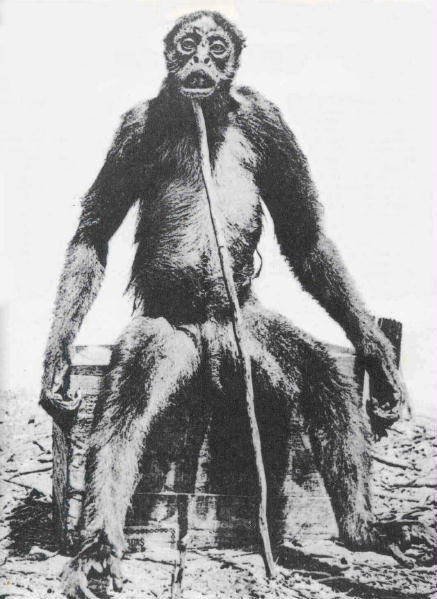
But getting back to Ham's pet "What-is-it", I suspect that this was because of  the then-recent story of a discovery of an unknown new species of ape by Francois De Loys.

Ameranthropoides loysi


From Wikipedia, the free encyclopedia


Ameranthropoides loysi
(de Loys' Ape
Didi)
Creature
GroupingCryptids
Sub groupingHominid, primate
Data
First reported1920
CountryColombia/Venezuela Border
RegionTarra River
HabitatRainforest
"Ameranthropoides loysi" (De Loys' Ape) is allegedly a large primate encountered by François De Loys in South America. Apart from testimony of claimed eyewitnesses, the only evidence of the animal is one photograph.
Controversy continues about the authenticity of the animal, with critics contending that the de Loys' Ape is a hoax and that the photograph shows only a posed spider monkey carcass, though cryptozoology enthusiasts and a few others support the notion that Loys did indeed encounter an unknown primate.[1]

Contents


 Encounter

François de Loys, a Swiss oil geologist, led an expedition from 1917 to 1920 to search for petroleum in an area along the border between Colombia and Venezuela, primarily near Lake Maracaibo. The expedition was unsuccessful, and furthermore suffered greatly due to disease and skirmishes with natives; of the 20 members of de Loys' group, only four survived.
According to de Loys' later report, in 1920, while camped near the Tarra River, two large creatures approached the group. Initially, de Loys thought they were bears, but then noted that they were monkey-like, holding onto shrubs and branches. The creatures – one male, one female – seemed angry, said de Loys, howling and gesturing, then defecating into their hands and flinging feces at the expedition. Fearing for their safety, the expedition shot and killed the male; the female then fled. De Loys and his companions recognized that they had encountered something unusual. The animal resembled a spider monkey, but was much larger: 1.57 meters tall (compared to the largest spider monkeys, which are just over a meter tall). De Loys counted 32 teeth (most New World monkeys have 36 teeth), and noted that the creature had no tail.
They posed the creature by seating it on a crate and propping a stick under its chin. After taking a single photograph, de Loys reported, they skinned the creature, intending to keep its hide and skull. Both items were later abandoned by the troubled expedition.
According to other reports, more photographs were taken but were lost either in a flood or during the capsizing of the scientists' boat.

 Publication

After de Loys returned to Europe, he kept the story of the unidentified ape to himself until 1929. That year, his friend the anthropologist George Montandon was perusing de Loys's files, seeking information about South America's native tribes. Montandon discovered the photograph, and thought it to be very important. De Loys finally related his account in the Illustrated London News of June 15, 1929, and three scientific articles regarding the creature were published in French journals. Montandon suggested a scientific name name for the creature: Ameranthropoides loysi.

 Controversy


A spider monkey (Ateles geoffroyi), for comparison. This species is not usually found where de Loys' specimen was shot however.
After this publicity, de Loys’ account was deemed unreliable by several critics, notably Sir Arthur Keith, a prominent anthropologist. Keith suggested de Loys was trying to pass off a normal spider monkey as something more exotic. The photograph did not clearly indicate the creature's size, and Keith also noted that by not photographing the creature’s posterior, de Loys had left open the question of whether or not it had a tail.
According to the cryptozoological researcher Ivan T. Sanderson, the particular area of South America in which de Loys allegedly found the ape has no reports of oversized hominids. Sanderson believes it to be nothing more than a spider monkey. He says of the mystery surrounding the ape, "it is an outright hoax, and an obnoxious one at that, being a deliberate deception."[2]
Another cryptozoologist, Loren Coleman, also supports the hoax theory, and even goes as far as to say that Montandon perpetrated it in order to support his views on human origin. Montandon had suggested the name Ameranthropoides loysi to propose that the specimen was a missing link ancestor of the Western Hemisphere's "red" people. He had previously stated that Africans evolved from gorillas and Asians from orangutans.[3] However, as researcher Richard Ravalli has pointed out, Coleman failed to point to any direct evidence of a hoax by either Montandon or de Loys.[4] Since then, research has come to light, noted on Coleman's blog, suggesting that the stump of a banana tree can be seen at the right side of the entire photograph. Bananas are not indigenous to South America, making their occurrence in the remote jungle highly implausible, thus making it probable that the photo was not shot at the location de Loys indicated.[5] This argument and other findings which strongly indicate a hoax, largely the result of Spanish-language work by Venezuelan scientists Bernardo Urbani and Angel Viloria, were essentially unknown to cryptozoology researchers prior to the summer of 2007. In 2009, Urbani and Viloria translated and published their findings in English.[6]
Others have argued that de Loys could have encountered an unknown creature. The crate the creature was posed on was similar to ones commonly used for transporting gasoline, which measured just under 18 inches tall. Assuming this crate was the common type, its size would appear to support de Loys’ measurement of the creature, although others say the crate is only 15 inches tall and the ape would measure under 4 feet - smaller than de Loys' claims. Researcher Michael Shoemaker, while noting some similarities to spider monkeys, argues that the creature has a few pronounced differences: its chest and hands are different; its face is much more oval than the spider monkey's distinctively triangular visage; it lacks the spider monkey’s pronounced underbite; and has a much higher forehead than spider monkeys.

 See also

 Sources

  • Jerome Clark, Unexplained! 347 Strange Sightings, Incredible Occurrences, and Puzzling Physical Phenomena (Visible Ink Press, 1993).
  • Bernard Heuvelmans, On The Track Of Unknown Animals (Hill and Wang, 1958).
  • Michael Shoemaker, "The Mystery of Mono Grande", Strange Magazine, April 1991.
  • Karl P.N. Shuker, Extraordinary Animals Revisited (CFZ Press, 2007).
  • Bernardo Urbani and Angel L. Viloria, Ameranthropoides loysi Montandon 1929: the History of a Primatological Fraud / Ameranthropoides Loysi Montandon 1929: la historia de un fraude primatologico (Libros en Red, 2009).
  1. ^ http://alchemipedia.blogspot.com/2009/10/de-loys-ape-ameranthropoides-loysi.html
  2. ^ De Loys' Ape - Unknown Hominid or Just a Hoax?
  3. ^ Newton, Michael (2005). "De Loys's Ape". Encyclopedia of Cryptozoology: A Global Guide. McFarland & Company, Inc.. pp. 128–129. ISBN 0-7864-2036-7.
  4. ^ Loren Coleman and El Mono Grande
  5. ^ De Loys’ Well-Known Prank
  6. ^ http://www.amazon.com/Ameranthropoides-loysi-Montandon-1929-Primatological/dp/1597544450

 External links


                                                            *               *                *

Here is the surviving photograph of the De Loys ape. It may or may not have been a hoax, but the story of this unknown ape could very well have been the inspiration of the "What-is-it" that was supposed to have been found in the same part of the world in the Doc Savage story DUST OF DEATH.


Chemistry:
http://www.supremeadventurer.com/chemistry.htm


Doc Savage Organized:
http://docsavage.org/


Doc Savage At Pulp Net:
http://www.thepulp.net/the-links/docsavage/


Doc Savage, Supreme Adventurer:
http://www.supremeadventurer.com/


Doc Savage Home Page:
http://www.docsavagelibrary.com/superhero-library/doc-savage/doc-savage-home-page.aspx


R