Octopus

Octopus
The Ominous Octopus
Showing posts with label Doc Savage. Show all posts

Monday, December 13, 2021

Doc Savage's Fabulous Five And The Fantastic Four

A


The Doc Savage team had many similarities to the later Fantastic Four.


In each case there was a small group of individuals operating out of a skyscraper, led by a superscientist against the forces of evil.


Jack Kirby Museum:

http://www.kirbymuseum.org/


A

Sunday, December 12, 2021

Superman And Doc Savage

S


Superman drew inspiration from Doc Savage, as can be shown in a series of comparisons .


The term "Superman" was used for Doc Savage first.


Doc Savage also had The Fortress of Solitude first.


Doc Savage also had a girl cousin in his stories first, Pat Savage.


Pat Savage with Doc on the cover of the issue with FEAR CAY:


A

Thursday, December 9, 2021

Doc Savage And His Amazing Crew

A


Who is Doc Savage?

An introduction from the back of one of the books:


WHO IS DOC SAVAGE?
To the world at large, Doc Savage is a strange, mysterious figure of
glistening bronze skin and golden eyes. To his amazing co-adventurers,
the five greatest brains ever assembled in one group, he is a man of
superhuman strength and protean genius whose life is dedicated to the
destruction of evil-doers. To his fans he is the greatest adventure hero
of all time, whose fantastic exploits are unequaled for hair-raising
thrills, breathtaking escapes and bloodcurdling excitement.

HIS AMAZING CREW—

WILLIAM HARPER "JOHNNY" LITTLEJOHN -- the bespectacled scientist
who was the world's greatest living expert on geology and archaeology.

COLONEL JOHN "RENNY" RENWICK -- the favorite sport of this
engineering genius was pounding his massive fists through heavy paneled doors.

LIEUTENANT COLONEL ANDREW BLODGETT "MONK" MAYFAIR –
only a few inches over 5 feet tall and yet over 260 pounds. His brutish
exterior concealed the mind of a world-renowned chemist.

MAJOR THOMAS J. "LONG TOM" ROBERTS was the physical weakling
of the crowd but a wizard at electricity and radio.

BRIGADIER GENERAL THEODORE MARLEY "HAM" BROOKS -- slender and waspy and the
greatest lawyer Harvard ever produced -- was never without
his ominous, black sword-cane.

PAT SAVAGE is Doc’s cousin from Canada with the same bronze hair and skin
and the same thirst for justice.

With their leader, they would go anywhere, fight anyone, dare everything –
all-the-while seeking excitement and perilous adventure!


*               *              *

They didn't used to list Pat Savage along with the guys on the back of the bantam reprints although she was in some of the stories, the description of Pat comes from one of the later books where they did list her with the others.

And here's an illustration of Pat Savage with the team from one of the later books:


Actually Pat Savage probably turns up more often in the new books by Will Murray than she did in the original series. She was the most important female character in Doc Savage adventures. Two other recurring female characters are Monja, the Mayan Princess who first appeared in THE MAN OF BRONZE and returned in THE GOLDEN PERIL and THEY DIED TWICE,


and Monk's pretty secretary Lea Aster, who was the main girl character in THE RED SKULL and occasionally mentioned in other stories afterwards.

Pat Savage was shown on the cover with Doc on the issue with FEAR CAY:


Here we have Doc Savage's Fortress of Solitude 


The Fortress of Solitude was Doc Savage's secret arctic base, which usually was only mentioned in the stories as somewhere Doc went. His usual base of operations was a skyscraper office building in New York, which is usually thought of as being the Empire State Building. Something which is not actually stated in the stories themselves.


A

Tuesday, April 30, 2019

Monk Mayfair, Guest Star


Monk and Ham both appeared as characters in Dave Stevens ROCKETEER, as did Bettie Page. The names Monk and Ham were not used for their characters in this story, but they are still recognizable as two of the sidekicks of Doc Savage.


Doc Savage himself appeared as a character in the story, but again the character's name was not used.


A

Monk Mayfair, Guest Star


Monk Mayfair was one of Doc Savage's "fabulous five", a team of adventurers whose exploits ran for years in the original magazine and were reprinted in a series of paperback books. But there was more to it than that. Apelike characters called Monk were used in other stories outside the series. It might not always have been because of the Doc Savage character, but it was in some cases.


Reference photo used by Bama for drawing Monk.


 The "Monk" appearing in the 1939 Universal serial THE PHANTOM CREEPS is similar.


There was no Ham, but in this serial Monk quarreled with Bela Lugosi's character a lot. This was unusual for serial henchmen in the serials of the time. Ordinarily they tended to do what they were told without a lot of arguing.

An resemblances could be coincidental, as they say, but then again they might not be.


The Monk Mayfair character was used in Ted White's CAPTAIN AMERICA AND THE GREAT GOLD STEAL,


which was published by Bantam books. This was the same publisher that was reprinting the Doc Savage stories, and it was similar to the Doc Savage books, except that here Monk was one of the bad guys. Monk got killed during the course of the story, but I don't supposed that mattered very much as Monk continued to
appear in other adventures afterwords. Doc Savage books are still being published, including some new adventures by Will Murray. 


CAPTAIN AMERICA AND THE GREAT GOLD STEAL:
http://bennypdrinnon.blogspot.com/2012/11/captain-america-and-great-gold-steal-by.html


A

Friday, April 26, 2019

Doc Savage And The Neotropical Viper

R


There is no mystery about the "neotropical viper" mentioned in the Doc Savage story, apart from the elements of mystery present in the story itself. It is something that is known to science.


                                                                 Magazine cover


Ad


Book cover


Neotropical area


Author Rick Lai had this to say:

From my book, THE REVISED COMPLETE CHRONOLOGY OF BRONZE:


"The Mystic Mullah's poison came from the "neotropical rattlesnake" (chap.
18). This species of snake actually exists, and is more formally called
Crotalus durissus. It is also known as the Central American rattlesnake."


Rick

* DOC SAVAGE Vol. 4 No. 5 (Jan 1935) "The Mystic Mullah" reprinted as
Bantam #9 (Nov 1965) Chapter XVII "The Green Face":*
**
*"If that green stuff touches you, it'll kill you!" Doc said grimly. "He
[Mystic Mullah] was using two kinds [of venom]. One only burned the skin
and produced senselessness. The other was mixed with the venom of the
neotropical rattlesnake."*
**
*"Neotropical—"*
**
*"Something like that," Doc rapped. "Venom of the neotropical rattler
centralizes its effects in the nervous system around the nape of the neck
and causes a form of nerve destruction which makes it appear that the
victim has a broken neck. The posion probably had additional ingredients
which heightened its effects, causing a muscular constriction which actuall
snapped the vertebrae in most cases."*
**
*(Note the weasel words "something like that" and the wiggle room added by
positing a combination of poisons.)*
**
*DND*


Phillip Jose Farmer didn't have a clue, as usual.


Wikipedia article:
http://en.wikipedia.org/wiki/Bothrops_insularis


THE MYSTIC MULLAH:
http://docsavagetales.blogspot.com/2011/03/pulp-of-week-doc-savage-23.html


THE REVISED COMPLETE CHRONOLOGY OF BRONZE:


A

Pat Savage


Pat Savage is Doc Savage's cousin and the most important female character in Doc Savage adventures.

FROM WIKIPEDIA

Patricia Savage
First appearanceDoc Savage Magazine vol 2, #5 (January 1934)
Created byLester Dent
Patricia Savage is a recurring supporting character in the Doc Savage pulps outside of "The Fabulous Five".
The character is presented as Doc Savage's cousin and sole living relative,[5] sharing the bronze hair color and skin tone with him as well as strikingly beautiful. The stories also note her as being an accomplished marksman, pilot, and hand-to-hand combatant.
She is also shown to love Doc's adventures to the point of joining them on occasion.
She uses a Colt Frontier Single Action .44 as her signature weapon, a family heirloom handed down from her grandfather[citation needed] and modified with a filed trigger and fanning spur. The gun was used as an important plot element in "Violent Night". In that story, a disguised Hitler thinks he's left his fingerprints on it, so Nazis keep trying to get the gun in order to protect his subterfuge.[6]
In "I died Yesterday", she is the main character as the story is told as a first person narrative.
She has also appeared or been mentioned in stories and novels that have been based on the pulps. These include:


                                               *                  *                    *


 I wrote part of that wikipedia article myself. Actually I wrote the wikipedia entry on Pat Savage in the first place, but it's been added to since then. Farmer's book on Doc Savage is mentioned.
Farmer is frequently guilty of misrepresenting the characters he wrote about in this and other books.


Pat Savage first appeared in the Doc Savage story BRAND OF THE WEREWOLF, as a cousin living in Canada. The werewolf business in the story seems to be a serious threat for much of the story, but turns out to be a hoax, something that frequently happens in Doc Savage adventures

Doc Savage's regular assistants, "the fabulous five", all like Pat Savage, but frequently try to keep her from getting involved in their adventures just as Doc himself does. Renny Renwick says Pat is "Excitopsychic" - pyschic to excitement - in the Doc Savage adventure WINGS OF DEATH. In the same story Pat invents a muffler for an airplane motor that makes it sound like a car motor, so she evidently shares Doc Savage's brilliance, even if it is not always as obvious.

According to Lester Dent, Pat Savage is Five foot seven inches tall. This is the same height given for Blondie by Chic Young*. And it would have been unusually tall for a woman in the thirties. Blondie was said to be about the same height as Dagwood, as a matter of fact.

Will Murray, who is still writing new Doc Savage books, continues to use the character of Pat Savage and she seems to be important in his stories.

BRAND OF THE WEREWOLF is said to have been the best-selling of Bantam reprint, selling over 185,000 copies.


Interior illustration from DOC SAVAGE magazine


DOC SAVAGE #19 seems to be the only issue in the original run to show her on the cover, along with Doc Savage. 


The height of Carole Landis was given as five foot six and a half, and I have sometimes thought that she would be a good Pat Savage. 


Carole Landis with a revolver. This is a more modern type of gun than Pat Savage was supposed to use.


Susan Hayward with old type sixguns similar to what Pat Savage was said to use. 


*BLONDIE, July 9, 1931.


BRAND OF THE WEREWOLF:
http://www.duskbeforethedawn.net/2009/06/brand-of-the-werewolf-doc-savage-5/

Pat Savage:
http://www.supremeadventurer.com/patricia.html
http://docsavage.wikia.com/wiki/Patricia_Savage

Pat Savage Fan Club On Yahoo:
http://groups.yahoo.com/group/Pat_Savage/


A

Sunday, November 4, 2018

Nautilus Article - MODERN MECHANIX


Here is a magazine article about the submarine Nautilus that made an unsuccessful attempt to travel under the polar icecap in the 1930's. I couldn't get one of the pages and have used the text from that page, which was still available.

Reblogged from http://blog.modernmechanix.com/will-the-nautilus-freeze-under-the-north-pole/#mmGal


Fantastic, at first glance, the Wilkins expedition certainly is. In fact, to the layman it is more than fantastic—it is suicidal. This opinion, incidentally, is concurred in by many submarine experts of the world’s navies, some of whom are quoted later on in this article. Even the sponsors of the trip have admitted the possibility of a great disaster which will snuff out the Nautilus and all aboard it. Yet every resource of science, every mechanical precaution which ingenuity can devise, is incorporated in the Nautilus to protect the submarine from anticipated dangers. The detailed drawing on page 48 shows the arrangement of the novel devices which make the Nautilus the most unique submarine in all history. Most of these devices—ice-cutting drills, sled runners, diving chambers, etc. —were designed by Simon Lake, veteran submarine inventor.
What are the dangers which will imperil the expedition? Some of the most obvious are these: The Nautilus may get caught beneath ice so thick that its 100-foot drills could not bore through it; consequently the submarine could not get air, without which the men would perish. Air is also essential to run the Diesel engines used to recharge the batteries which drive the sub under water. For eight hours out of the 24 the sub must lie on the surface recharging the batteries.
The bow of the Nautilus, reinforced with concrete though it is, may be damaged by collision with obstacles sufficient to spring a leak and flood the interior.
Batteries may be discharged more rapidly than calculated, leaving the submarine powerless.
Damaged propellers or control surfaces jammed with ice may not be amenable to repair by divers.


The submarine that Doc Savage had in THE POLAR TREASURE was presumably similar to the one that was described in this article.


A

Doc Savage And The First Submarine Polar Expedition


Doc Savage tried to take a submarine under the North Pole in the 1930's, years before the atomic submarine "Nautilus" made the trip. But another submarine had tried to make the trip even before the Doc Savage story was written. And it too was named the "Nautilus"*.


USS O-12 (SS-73)

From Wikipedia, the free encyclopedia
Jump to: navigation, search
Nautilus in Bergen
Nautilus in Bergen
Career
Name:USS O-12
Ordered:3 March 1916
Builder:Lake Torpedo Boat Company, Bridgeport, Connecticut
Laid down:6 March 1916
Launched:29 September 1917
Commissioned:19 October 1918
Decommissioned:17 June 1924
Renamed:Nautilus, 24 March 1931
Struck:29 May 1930
Fate:Scuttled, 20 November 1931
General characteristics
Type:O class submarine
Displacement:491 long tons (499 t) surfaced
566 long tons (575 t) submerged
Length:175 ft (53 m)
Beam:16 ft 7 in (5.05 m)
Draft:13 ft 11 in (4.24 m)
Propulsion:Diesel-electric
2 × 500 hp (373 kW) Busch Sulzer diesel engines
2 × 400 hp (298 kW) Diehl electric motors
1 shaft
18,588 US gallons (70,360 l; 15,478 imp gal) fuel
Speed:14 knots (26 km/h; 16 mph) surfaced
11 knots (20 km/h; 13 mph) submerged
Test depth:200 ft (61 m)
Complement:2 officers, 27 men
Armament:• 4 × 18 in (457 mm) torpedo tubes, 8 torpedoes
• 1 × 3"/50 caliber deck gun
USS O-12 (SS-73) was an O-class submarine of the United States Navy. Her keel was laid down on 6 March 1916 by the Lake Torpedo Boat Company in Bridgeport, Connecticut.
These later O-boats, O-11 through O-16, were designed by Lake Torpedo Boat to different specifications than the earlier Electric Boat designs. They performed poorly as compared to the Electric Boat units, and are sometimes considered a separate class.
O-12 was launched on 29 September 1917, sponsored by Mrs. Homer S. Cummings, and commissioned on 18 October 1918 with Lieutenant Commander J.E. Austin in command.

Military career

O-12 spent much of her career as a unit of Submarine Division 1, based at Coco Solo, Panama Canal Zone. In 1921, she was awarded a Battle Efficiency Pennant and trophy for gunnery (gun and torpedo). She decommissioned on 17 June 1924 after just five and a half years of service, and was placed in reserve at the Philadelphia Navy Yard.

Nautilus Arctic Expedition

Struck from the Naval Vessel Register on 29 July 1930, ex-O-12 transferred to the United States Shipping Board for conversion by the Philadelphia Navy Yard. She was leased at the rate of one dollar per year to Lake and Danenhower, Inc., of Bridgeport, Connecticut, for use on Hubert Wilkins's and Lincoln Ellsworth's Arctic Expedition of geophysical investigation. The lease required that she either be returned to the Navy for disposal, or scuttled in at least 1,200 feet (370 m) of water.
On 24 March 1931, she was re-christened Nautilus. As Prohibition prevented the use of an alcoholic beverage, she was baptised not with the traditional champagne but rather with a bucket of ice cubes. Great French writer Jules Verne's grandson was present at the event, under the French flag, along of course with Sir Hubert's young and glamorous new-wed wife, actress Suzanne Bennett.
Simon Lake equipped Nautilus with several clever devices for under-ice operations. One was a mechanical probe, much like a trolley pole, that would scrape along the bottom of the ice cap to indicate how much clearance the submarine had below the ice. Others included drills supposedly capable of cutting through 13 feet (4 m) of ice to reach fresh air.[1] These innovations were tested only cursorily before the boat put to sea.[2]
Nautilus with her crew of 20 men was commanded by Captain Sloan Danenhower, son of John Wilson Danenhower, who served aboard USS Jeannette during her Arctic expedition. Nautilus, on 4 June 1931, began the crossing from New York City, United States, to Plymouth, England, the first leg of the voyage that was planned to take them up the coasts of the North Sea to Spitsbergen and conclude with a dramatic rendezvous at the North Pole with the German airship Graf Zeppelin. On that first leg, however, Nautilus encountered a violent storm. Both engines failed, leaving the boat adrift. She was rescued and initially towed into Cork Harbour in Southern Ireland on 22 June where her batteries were re-charged,[3] before being towed to England by USS Wyoming (BB-32) where she was repaired.
On 5 August, very late in the year to begin an Arctic expedition, Nautilus began making her way through the English Channel and along the Norwegian coast. Another storm again damaged the boat, carrying away her bridge and giving her a permanent list, but after a stop in Tromsø on 11 August, she successfully reached Spitsbergen, and Wilkins allowed but a single day for repairs.
The crew carried out the planned scientific experiments as they pushed on northward, but thick pack ice hindered their progress. The boat was ill-equipped to deal with the extreme cold, lacking insulation and heaters. The fresh water system froze and the hull developed slow leaks.
After ten days, Nautilus reached 82°N, the farthest north any vessel had reached under its own power, and preparations began to dive and proceed under the ice. However, the boat refused to respond; the stern planes had been carried away at some unknown earlier time. Without them, the submarine could not control its depth while submerged, and the expedition had to be aborted.
On 31 August, under financial pressure from Hearst, who indicated by telegraph that Wilkins would not be paid if he did not continue, Wilkins ordered the submarine onward. Captain Danenhower ordered Nautilus trimmed down by the bow, and deliberately rammed an ice floe in an attempt to force the boat under. The manoeuvre worked in that Nautilus submerged, and became the first submarine to operate under the polar ice cap. However, her unconventional method of diving caused significant damage to her upper works. She was out of radio contact for days, was presumed lost, and rescue efforts were planned. In fact, she had actually travelled only a short distance under the ice before resurfacing through a polynya, but her radios had been badly damaged, requiring days to repair.
The scientific crew continued their experiments, and their findings became the first paper published by the Woods Hole Oceanographic Institution. On 20 September, Nautilus returned to Spitsbergen carrying invaluable data and with all crew alive. Hearst, however, considered the expedition a failure and carried out his threat, refusing to pay for the expedition.

Ultimate Fate

Following the expedition, O-12 was returned to the Navy Department. On 30 November 1931 she was towed three miles down the Bufjorden (a Norwegian fjord outside Bergen) and scuttled in 1,138 feet (347 m) of water. In 1981 Norwegian divers found her wreck.
In 1959, USS Skate (SSN-578) was the second submarine (after USS Nautilus (SSN-571) in 1958) to reach the North Pole. Her crew conducted a tribute to Sir George Hubert Wilkins and scattered his ashes over the North Pole.

References

  1. Jump up ^ "Polar Sub Can Drill Through Ice", April 1931, Popular Science cutaway drawing
  2. Jump up ^ McLaren, Alfred S., CAPT USN "Under the Ice in Submarines" United States Naval Institute Proceedings July 1981 pp.105–106
  3. Jump up ^ Cork Examiner 23 June 1931

External links


                                               *                     *                    *


Drawings of the polar submarine Nautilus, the inspiration for Doc's Helldiver.


Reblogged from "The Wild Adventures Of Doc Savage" on facebook.


*The Nautilus had been the name of the submarine operated by Captain Nemo in Jules Verne's novel TWENTY THOUSAND LEAUGES UNDER THE SEA. In the story that submarine had traveled across the pole under the icecap, among other things.


THE POLAR TREASURE:
https://docsavage.org/2017/06/the-polar-treasure/


Nautilus Polar expedition of 1931:
http://www.ussnautilus.org/events/2006Jun23nautilus1931/nautilus1931.shtml

http://ussnautilus.org/blog/hubert-wilkins-and-his-submarine/


Simon Lake and the Nautilus:
http://www.simonlake.com/html/nautilus.html


Jules Verne's fictional Nautilus:
https://en.wikipedia.org/wiki/Nautilus_(Verne)


A

Tuesday, May 20, 2014

Doc Savage Meets The Oomph Girl Of The Movies

R


 In the Doc Savage adventure THE HEADLESS MEN, Monk calls a redhead named Lynda Ladore "The Oomph Girl of the movies". That would make her Ann Sheridan, who was termed "The Oomph Girl" at the time. The name "Lynda" means "pretty" in Spanish, while in French "L'dore"
would mean "the love".


Reblogged from http://www.goodreads.com/book/show/1159016.Devils_of_the_Deep_The_Headless_Men


The Headless MenA mad scientist has invented a way to decapitate people and let them live as his headless slaves. The Man of Bronze and his crew pursue this deadly genius to Central America, where they are all trapped and captured. Only Doc Savage can prevent the headless horde from taking over the world — but he is strapped to a sacrificial altar and is scheduled to lose his head at midnight!
Authored by Alan Hathway.


                                                    *                           *                          *


During the course of this story Monk and Ham disguise themselves as "headless men" by making it look as if they don't have any heads. During this period they are unable to speak to each other and must resort to mental telepathy in order to continue their usual bickering over things like apes and pigs. A most unusual ability that they probably never used again afterward.


Download THE HEADLESS MEN
http://ebookbrowse.com/doc-savage-the-headless-men-pdf-d220930563


A

Monday, January 27, 2014

Fanny Brice - DOC SAVAGE - 1943


Fanny Brice was a Broadway star who became even more famous for playing a little girl character called "Baby Snooks" on the radio. Here is the story of her life, as told by the makers of DOC SAVAGE comics.


Reblogged from http://fourcolorshadows.blogspot.com/


A

Tuesday, November 26, 2013

Doc Savage - "The Earth Wreckers"

R


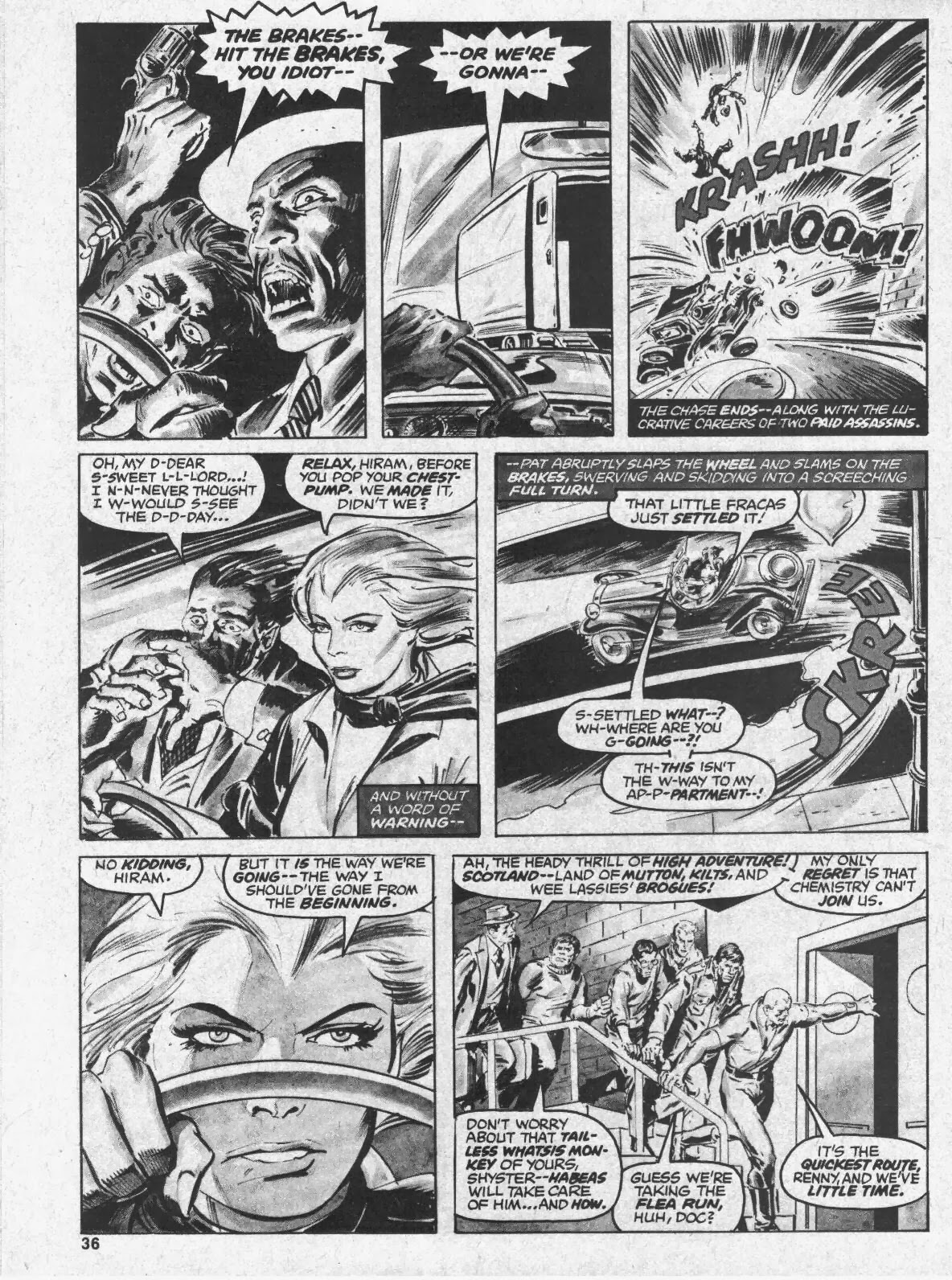
This is a Doc Savage comic book that Marvel Comics published in the 1970's. The story is set in the period in which the pulp magazines were originally published.  Doc Savage's "fabulous five" and his cousin Pat all appear with him in this adventure.


Reblogged from http://diversionsofthegroovykind.blogspot.com/2010/07/black-and-white-wednesday-earth.html


A